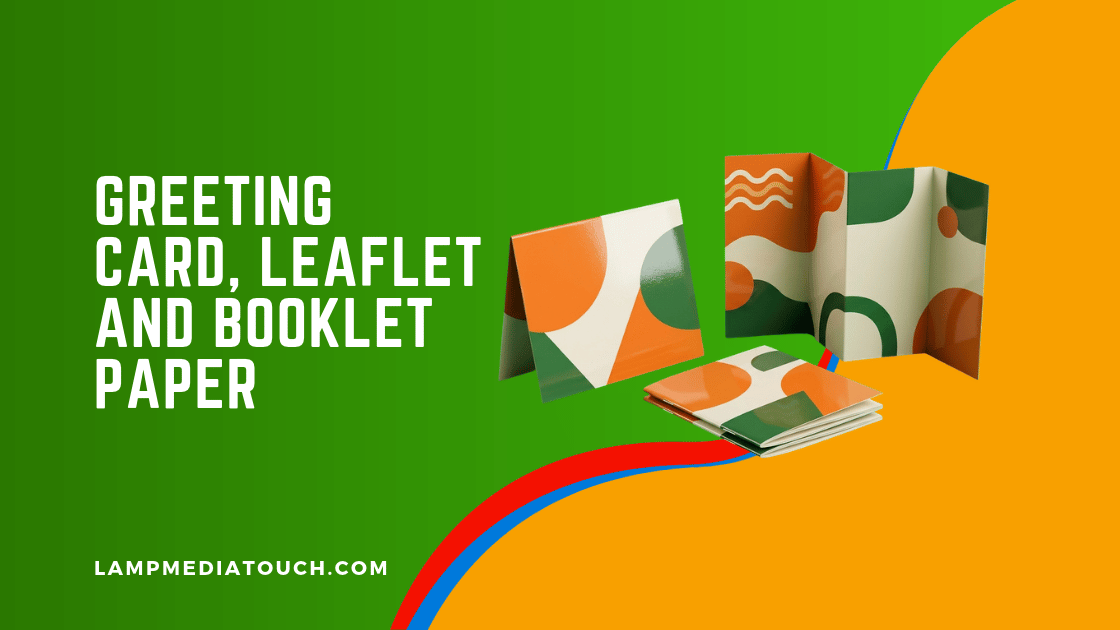
Choosing greeting card paper is a balance. The card must be firm enough to stand and be kept, but light enough to fold cleanly. The same question applies to leaflets and booklets, where the paper must be pleasant to hold and easy to turn.
This guide explains the greeting card paper we use, the paper for leaflets and booklets, and how to avoid common folding problems.
Table of Contents
Table of Contents
The greeting card paper we use
For greeting cards we use 130 GSM matte or art paper. It is heavier than a flyer sheet, smooth enough for good colour and photos, and flexible enough to fold along a crease. Some customers prefer a firmer card, and for those we can use matte card, but a thick card needs careful creasing so it does not crack along the fold. See 250gsm matte card.
Leaflets and booklets
A leaflet is a printed sheet, often folded, that tells people about a business, an event or a product. Leaflets that are joined together form a booklet or a journal. For these jobs we use the same 130 GSM matte or art paper, because it is pleasant to hold, takes colour well and turns easily.
For notebooks and journals, you can also look at our Custom Printed Jotters, which have a printed cover and a spiral binding.
Which paper for which folded job?
| Job | Paper | Notes |
|---|---|---|
| Greeting card | 130 GSM matte or art paper | Folds well and carries colour and photos |
| Leaflet | 130 GSM matte or art paper | Light, easy to carry and hand out |
| Booklet or journal | 130 GSM matte or art paper | Turns easily and takes colour well |
| Firm invitation-style card | 250 GSM matte card | Stiffer; crease carefully |
How to avoid folding problems
- Choose a paper weight that matches how much you need to fold. Heavier paper cracks more easily.
- Keep important text and images away from the fold line.
- Leave a safe margin around the edges so nothing is cut off.
- Use a print-ready file with fold marks if the layout is complex. See print-ready PDF.
- Ask for a sample fold before a large batch.
When to use card instead
If you want a greeting card that feels premium and stands upright on its own, a firmer card is worth considering. Remember that a stiff card is also less forgiving to fold. For more on choosing, see which paper for printing.
Choosing greeting card paper by occasion
Birthday and celebration cards look best with bright colours and photos, which suit a smooth matte or art paper. Cards that will be signed or written in, such as thank-you and condolence cards, work well on a matte surface, because a pen writes on it more easily than on a glossy one. Whatever the occasion, the right greeting card paper should feel pleasant to hold and fold cleanly.
What paper is best for greeting cards?
We use 130 GSM matte or art paper for greeting cards. It folds well and prints colour clearly.
What paper do you use for leaflets?
We use 130 GSM matte or art paper, which is easy to carry and takes colour well.
Can a booklet be printed on matte paper?
Yes. Leaflets joined into a booklet or journal use the same matte or art paper.
Does thick card crack when folded?
It can, if it is not creased properly. Choose the weight to suit the fold.
Printing greeting cards or booklets?
Tell us the job, the quantity and the paper you have in mind. If you are not sure which paper suits it, ask before you print.
Paper printingCard printingRequest a quote