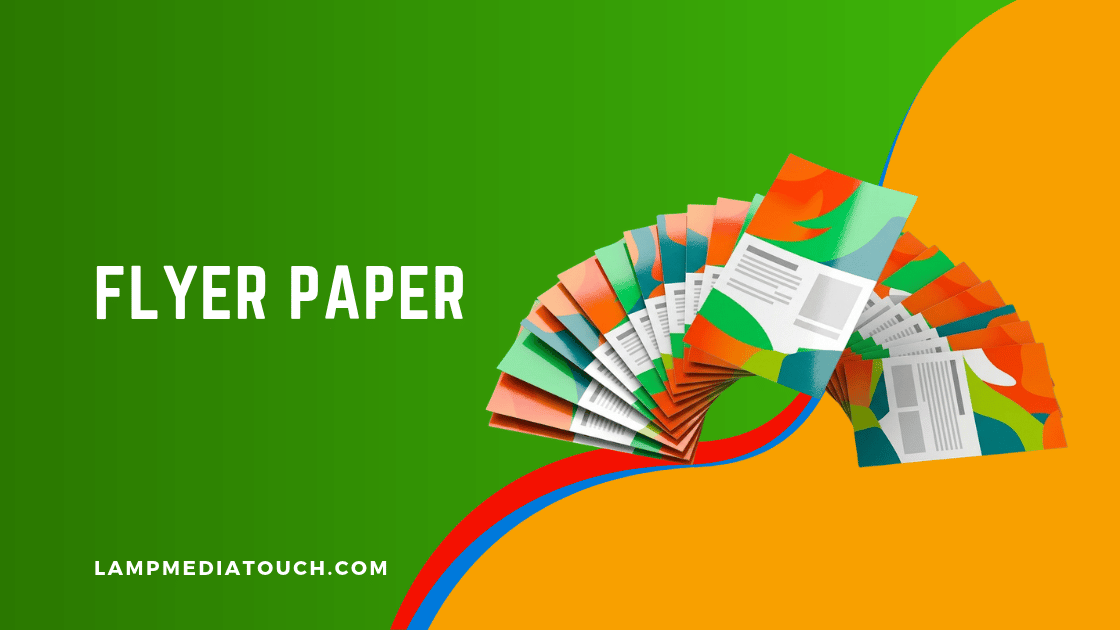
The flyer paper you choose decides whether your flyer is picked up, read and kept, or dropped on the ground. A flyer that is too thin feels cheap and shows the print through. A flyer that is too thick is more expensive than it needs to be and does not suit a quick handout.
This guide explains the flyer paper we use, why we recommend it, how it compares with card, and what to check before you print a large batch.
Table of Contents
Table of Contents
The flyer paper we use
For flyers we use 130 GSM matte paper, which many customers call art paper. A lighter 115 GSM is also available. We settle on 130 GSM because it feels solid in the hand, carries colour and images well, and still folds and stacks easily. You can read about the two names in art paper vs matte paper.
Why 130 GSM works well for flyers
- It feels like a proper flyer. It is heavier than office paper, so people treat it with more respect.
- It shows less through the page. Print on the back is less visible from the front.
- It carries colour well. The coated surface suits bright designs and photos.
- It is practical. It is still light enough to carry in numbers and hand out.
Flyer paper vs plain paper vs card
| Plain bond paper | 130 GSM matte paper | 250 GSM matte card | |
|---|---|---|---|
| Feel | Light, like a document | Solid but light | Stiff |
| Best for | Documents and plain prints | Flyers and leaflets | Invitations and cards |
| Colour and images | Basic | Good | Good |
| Handing out in bulk | Easy | Easy | Heavier to carry |
For a standard flyer, 130 GSM is usually the right middle ground. Choose card only if the flyer doubles as a keepsake, such as an invitation or a coupon card. See 250gsm matte card.
Sizes for flyers
Flyers are commonly printed on A5 or A4 sheets. A5 is half of A4. We cut paper to A3, A4 and A5, so tell us your design size and we will confirm the best sheet. For more on sizes, read A3, A4 and A5 paper sizes.
Before you print a large batch of flyers
- Check the text, phone number and address. A mistake repeats on every copy.
- Make sure your phone number is large enough to read. See readable text on small labels.
- Use a print-ready PDF. See print-ready PDF.
- Remember that screen colour and print colour differ. See why print colour differs from screen colour.
- Start with a small test batch if the design is new.
To design a flyer that works, read how to design a business flyer. For the general cost picture, see printing cost in Nigeria.
What paper is best for flyers?
We recommend 130 GSM matte or art paper for flyers. It feels solid, carries colour well and is easy to hand out.
Can flyers be printed on 115 GSM paper?
Yes. 115 GSM is lighter and a little cheaper in feel. We use 130 GSM as our standard.
Is card too thick for a flyer?
Card is stiffer than most flyers need. Use it if the flyer is also an invitation or a keepsake.
What size should a flyer be?
A5 and A4 are the most common. We cut paper to A3, A4 and A5.
Printing flyers?
Send your file and the quantity. We will recommend the paper and confirm the size.
Paper printingCard printingRequest a quote