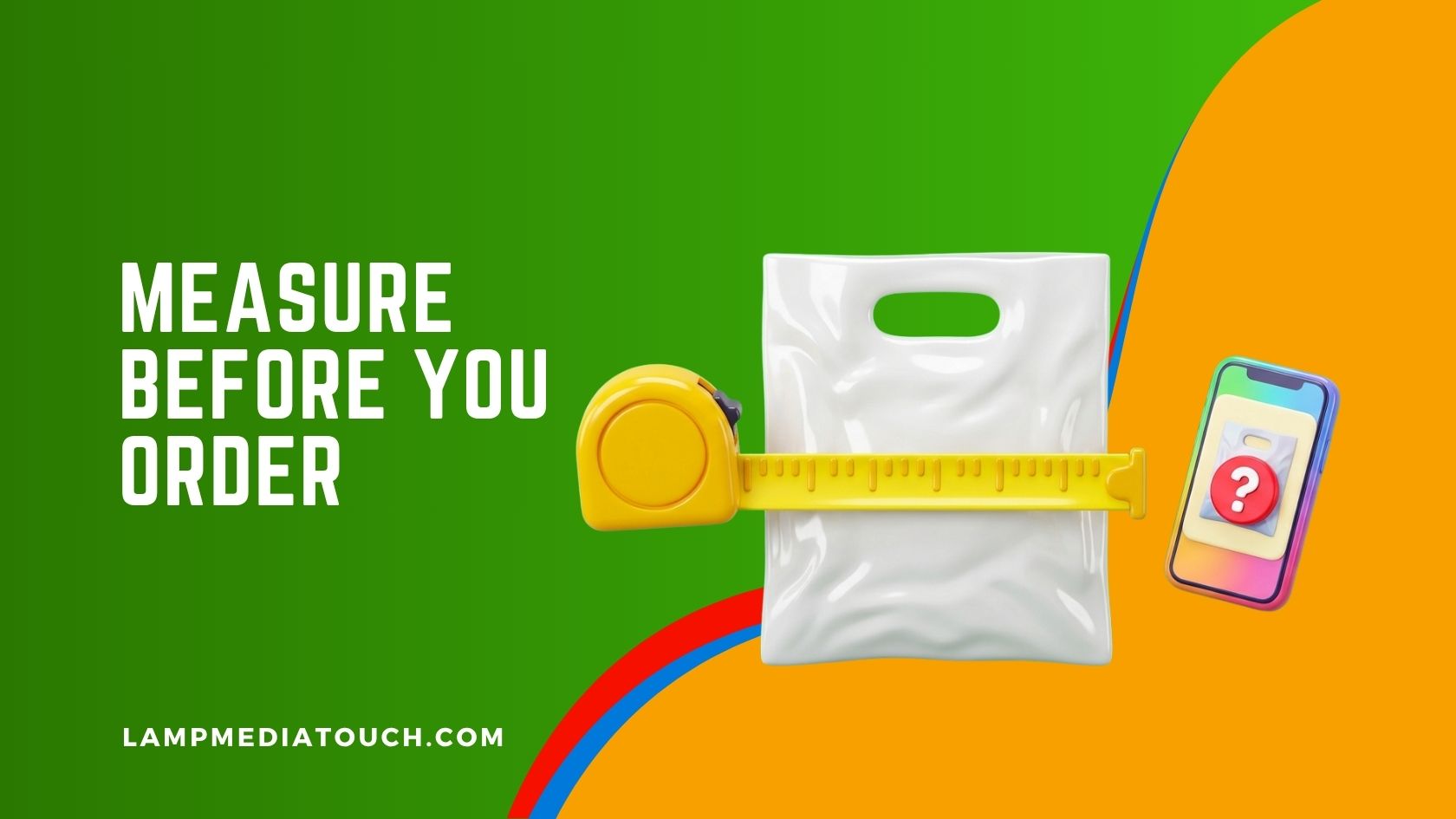
When you need to measure nylon bag size before an order, the most dangerous shortcut is judging it from a picture. A phone photo, a screenshot or a size list on a page can look clear and still lead you to the wrong bag. A wrong bag is not a small problem. Once it is printed with your logo, it cannot be returned to the shelf, and you may have a stack of bags you cannot use.
This guide explains why looking at a size online can mislead you, how to measure your goods properly, and why you should check every size list yourself, even when your printer sends it to you.

Table of Contents
Table of Contents
Why looking at a size online can be misleading
A picture of a bag cannot tell you its real size. Several things distort it:
- No scale. Without a ruler or a known object next to it, a bag can be any size.
- Camera distance and angle. A bag held close to the lens looks larger than one photographed from far away.
- Screen size. The same picture is small on a phone and large on a laptop, so your sense of size changes.
- Packed or flat. A bag photographed with items inside looks different from a flat empty bag.
- Mixed-up names. Names such as short, long, small or big mean different things to different people. Only the measurements in inches mean the same thing to everyone.
A real example: a client judged a bag from a phone photo, in spite of having been sent the size list to confirm. He picked the short stationery bag instead of the long one. The order was printed, and the bags did not fit his goods. They were of no use to him. Checking with a tape measure would have caught it in a minute.
Why a flat bag is smaller than it looks
This matters most when you measure nylon bag size for stacked or boxed goods, because the thickness of the goods changes how much room you need.
Nylon bags are measured flat, before anything goes in. When you put in an item that has thickness, a box, a folded shirt or a stack of plates, the sides of the bag pull inwards, and the space you can actually use gets smaller. As a polybag sizing guide explains, a flat bag cannot hold an item with the same flat dimensions.
This is why you should always choose a bag that is a little bigger than the flat size of your goods, not an exact match.
How to measure nylon bag size for your goods
- Pick the real item, in the form your customer will receive it: boxed, folded, wrapped or stacked.
- Measure the width across the widest part with a tape measure or a ruler.
- Measure the height from the bottom to the top.
- Measure the thickness at the thickest point. A soft item such as a shirt gets thicker once folded.
- Write the three numbers in inches. Printers’ size lists are in inches.
- Add room. Allow some extra space on the width and the height so the bag closes and the goods go in easily.
- Compare with the size list in our guide on nylon bag sizes in Nigeria and pick the smallest bag that fits comfortably.
| Measure | What to write down | Why it matters |
|---|---|---|
| Width | Widest part of the goods, in inches | Decides whether the bag is wide enough |
| Height | Bottom to top, in inches | Decides whether the bag is tall enough |
| Thickness | Thickest point, in inches | A thick item pulls the sides in and needs a bigger bag |
| Quantity per bag | How many items go in one bag | Three plates need more room than one |
Measure the goods in the form your customer receives them.
Verify every size list yourself
Whenever you measure nylon bag size, treat the first number you get as a draft. Measure twice, then check it against a real bag or a paper template.
Even when a printer sends you a size list, check each size with your own eyes. Lists can be copied wrongly, names can be confusing and your idea of long and short may be different from ours. Here is how to verify a size in a few minutes:
- Make a paper template. Cut a sheet of paper or cardboard to the bag’s width and height in inches.
- Put your goods on it. Fold the template around the goods to see if they fit.
- Ask for a sample. If you can, hold the real bag or a similar one in your hand.
- Order a small batch first when you are unsure, before a bigger run.
- Confirm the size in writing with your printer, using inches, before you approve the order.
A business we spoke to recently did exactly this. They tested all four sample sizes with their real goods in their own office, saw what each could hold, and then ordered the sizes that suited them, 50 pieces of each. The decision took a short visit and saved them from guessing.
Checklist: how to measure nylon bag size before you order
- Did you measure the real goods, in inches?
- Did you allow room for thickness?
- Did you check the size on a paper template or a sample?
- Did you confirm the size name and the measurements in writing?
- Did you choose the size by measurement, not by a photo?
When the numbers are right, you can order with confidence. See the five sizes in our guide to nylon bag sizes in Nigeria, or look at the printing options in screen printing nylon bags.
How do I measure nylon bag size for my goods?
Measure the width, height and thickness of your goods in inches, in the form your customer receives them, then choose a bag a little bigger than the flat size.
Why is a nylon bag smaller than its listed size once filled?
A bag is measured flat. When an item with thickness goes in, the sides pull in and the usable width and height shrink.
Can I trust a photo to measure nylon bag size?
No. Camera angle, distance and screen size can make a bag look bigger or smaller than it is. Always rely on measurements in inches and test with your goods.
What should I do if I am not sure which size to choose?
Use a paper template, ask for a sample, or order a small batch first. You can also ask us before you order.
Need help confirming a size?
Choose your size, quantity and number of printing colours on the product page, with or without design. Not sure which size? Ask us before you order.
See all nylon bagsRequest a quote